
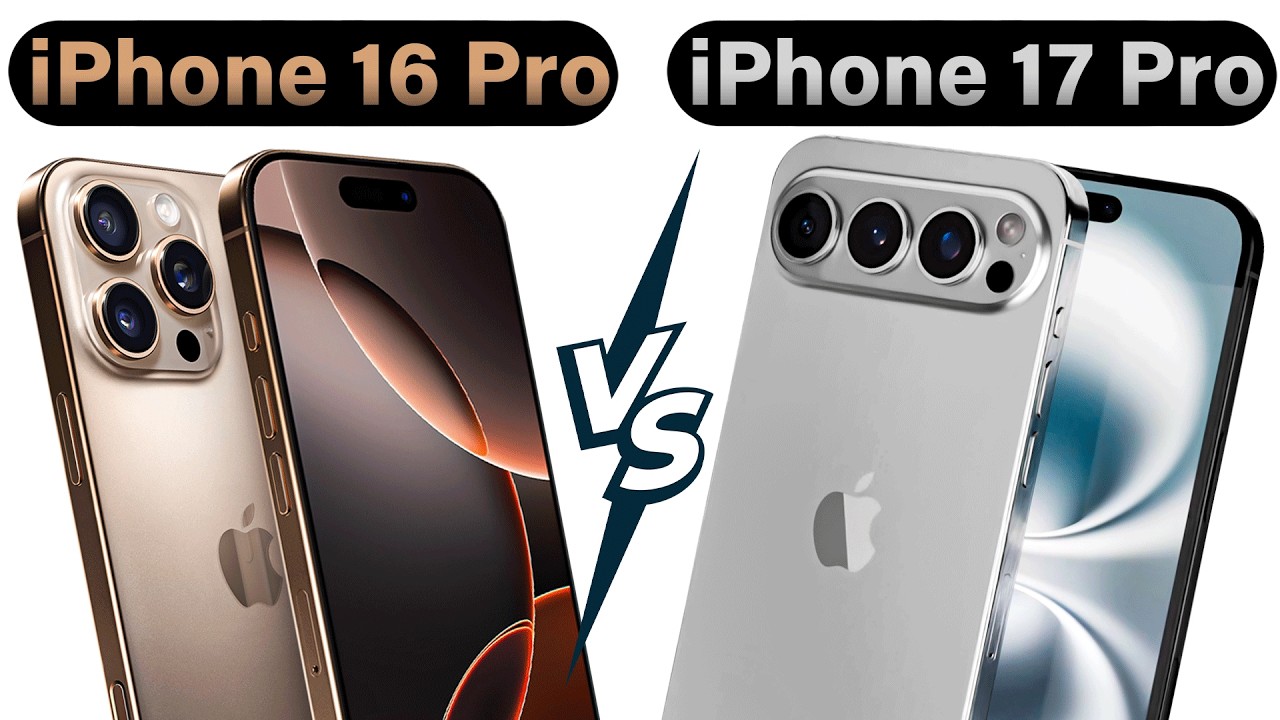
iPhone 17 Pro Max vs. iPhone 16 Pro Max: The Full Comparison
Hi everyone, BMathz here for Review. And with the launch of the all-new iPhone 17 Pro Max, Apple has changed quite a bit from the design to some of the features and more. So, I thought we’d compare it with the 16 Pro Max to help you decide which one would be best for you. Whether you’re thinking of upgrading from the 16 Pro Max to the 17 Pro Max or from an older phone as well. So, we’ll compare everything from the display, battery life, cameras, and more.
Pricing and Availability
Now, the first thing is the iPhone 16 Pro Max is no longer for sale new from Apple. Every year when they introduce a new Pro model, they discontinue the old model on their website and in their Apple stores, but you can still get them through third-party retailers. So, just keep that in mind. They may be reduced prices, but when it was new, it started at $1,199. It went up to $1,599. And there were three storage options. 256, 512, and 1 TBTE.
With the iPhone 17 Pro Max this year, Apple has added an additional storage option. So, it starts at the same $1,199 with $256 gigs of storage and goes up to 2 TB at $1,999. So, if you want that extra option, it’s there if you need that additional storage.
Colors
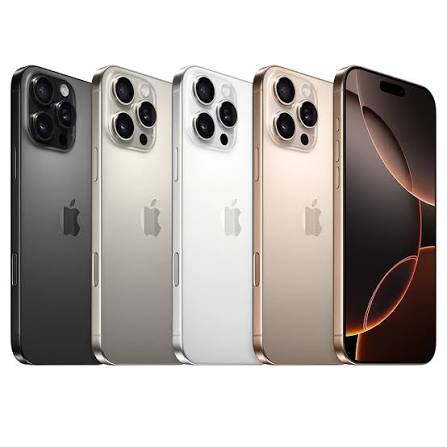
Now, when it comes to colors, the iPhone 16 Pro Max had four different color options. And if you pick those up, you’ll have black or black titanium, white titanium, natural titanium, and desert titanium. With the 17 Pro Max, Apple only has given us three colors this year with a cosmic orange, deep blue, and silver. So, more colorful options, and then more of a plain option, but no black option this year.
Build and Materials
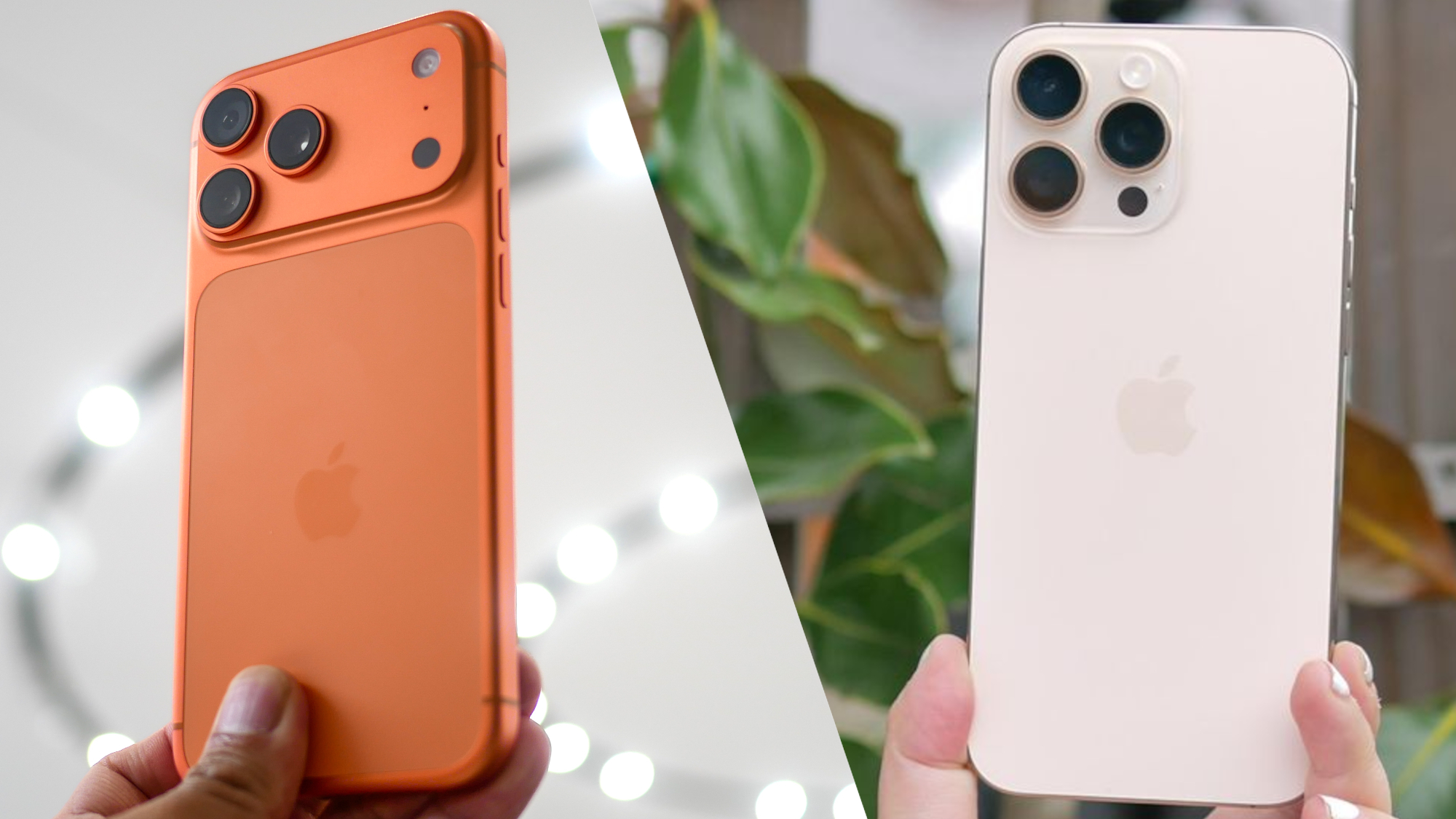
When it comes to build and materials, well, this is a big change. as the previous two years we had titanium and that’s maybe due to the lack of colors why we didn’t see them on this particular device but the overall durability of titanium is quite good. It’s very strong. Some of the overall coating could scuff off depending on which color you chose like you can see here. But overall it’s very durable and fairly standard as far as what to expect. So titanium on the outside and then ceramic shield front and back with our typical camera layout.
With the iPhone 17 Pro Max, Apple has abandoned titanium in favor of aluminum or aluminum, and they’ve sort of inserted this glass piece in the back as well. They’ve really focused on dissipating heat, and it’s sort of a uni-body design that really helps get rid of heat pretty well overall. So, you can see it’s an anodized aluminum, and durability-wise, there has been some concerns. However, just setting this down on things such as tile or maybe a marble countertop. I’ve even dropped this on rocks, and I don’t have a single scuff on it yet. So, I think it’s more durable than others have experienced, but it doesn’t mean it won’t dent more easily than titanium, but just keep that in mind.
Durability and Screen Protection
Now, again, both have ceramic shield on the back this time. And on the front, we have a new ceramic shield, ceramic shield 2, that Apple says is three times better at scratch resistance. Now, dropping it on a rock, you can see there’s actually a nick in the display right here. So, if we turn the display off and dim it to the always on display, you can see there’s a little scratch in the display. And if I turn the always on display off, you can see a chip a little bit better there.
Now, keep in mind this actually fell off a tripod directly onto rocks at about the distance of 4 feet. And there’s no scuffs or scratches on the aluminum at all. So, just this glass was hit and it didn’t crack or anything like that. So, it actually held up pretty well. And it seems to be fairly durable. So, no real issues there other than unfortunately my new phone has a scratch on it. But, it wasn’t from me holding it or dropping it normally. it was just from falling off a tripod, unfortunately.
Dimensions and Weight
Now, when it comes to the dimensions, they’re slightly different this year, but very slightly different. For example, the iPhone 17 Pro Max is slightly taller, slightly wider, and slightly thicker. This is great news for the battery, and we’ll talk more about that in a moment.
And the weight is slightly different as well. The iPhone 16 Pro Max comes in at 7.99 oz or 227 g. And the iPhone 17 Pro Max comes in at 8.22 22 oz or 233 g. So, it’s not a huge difference, but you can feel the difference in your hands. It’s smoother around the edges with the 17 Pro Max, and I actually like the feel of it a little bit more as far as the texture. If you put a case on them, you won’t really notice the difference really, but the overall comfort of it, I really like the 17 Pro Max this year.
Battery Life and Longevity
Now, the overall weight difference this year seems to be due to a larger battery. The iPhone 16 Pro Max comes in at 4,685 milliamp hours and is good up to 33 hours for video playback. This year’s iPhone 17 Pro Max has a 5,88 mAh battery, good for up to 39 hours of video playback. Now, if you have a phone that has a SIM card tray, as some do across the world, you get about 2 hours less of video playback compared to what we have in the United States with no SIM card. But still, it’s better than the 16 Pro Max.
And when it comes to overall battery life, I used my 16 Pro Max for an entire year and the 17 Pro Max I used for an entire week while I reviewed it. So overall battery life, it easily got me through the day. Some people are seeing 50% by the end of the day, but you can see here because I haven’t used it in a little while. I’m reviewing another phone right now. I had 65% of my battery used and had 4 hours and 14 minutes of screen active time, 7 hours and 22 minutes of screen idle time.
The 16 Pro Max probably won’t have most of this data here, but we’ll take a look. And typically, I would use about 100% of the battery and only use 4 to 6 hours of screen on time. Of course, I tested a lot of betas during that time, and it seemed to hold up pretty well. The battery definitely held up better than the previous year as far as the overall battery health with 337 cycles, giving me 93% maximum capacity. Of course, with the 17 Pro Max, it’s going to be a while before it drops. We’re only at seven cycles with 100% capacity. So, I would expect similar life out of both of them. Apple says it’s good for about a,000 cycles, which should bring you down to around 80% or a couple years of usage.
Charging Speeds
Now, to go along with the larger battery life, we also have faster charging this year for the first time in many years on iPhone. The iPhone 16 Pro Max can charge wired at about 50% in 30 minutes. Apple said, basically, use a 20 watt adapter or higher and you’ll get that speed. The same is true with a 30 watt adapter or higher MagSafe charger in the 16 Pro Max.
But this year with the 17 Pro Max, we have 25 watt MagSafe charging that’s G2 compatible. So it charges 50% in 30 minutes with the wireless adapter on the back with Mags Safe. Or using a 40 watt or higher charger, you can get 50% in just 20 minutes. So it’s definitely a lot faster. It can dissipate that heat better and hopefully prolong battery health as well.
Sponsor: Taurus Chargers
And to take advantage of the new faster charging speeds of the new iPhone 17 Pro Max, today’s sponsor, Taurus, has some new chargers that are not only fast, but also stay cool in a compact size. The Flex Line 67 watt charger uses gallium nitride technology and dual custom cooling chips to keep temperatures up to 8° C lower than the original charger while fast charging iPhone without excess heat. The charger also has a built-in 1-meter cable that retracts into the charger and is super durable using an aerospace grade alloy and is designed to last at least 10 years. It also self-aligned utilizing a magnetic locking device for precise alignment. The charger is great for travel and compact. And you can also charge two devices at once with enough power to charge an iPhone to 65% in 30 minutes and power a laptop at the same time.
Taurus also has the Mini Mag power bank to power your iPhone on the go. It has an ultras slim and lightweight design that’s comfortable to hold but also durable. It holds a 5,000 mAh battery designed for durability and uses an aluminum design to help dissipate heat. While it charges at 18 watts wired or 7.5 watts when using the wireless charging to check out the latest chargers from Taurus, I’ll leave a link in the description below. So, be sure to check them out there.
Display Features and PWM Smoothing
Now, the next thing is the display. I mentioned it a little bit before, but one of the nice things they’ve done this year is add an anti-reflective coating. Now you may or not may may not be able to see it as well. It cuts it down by about 50%. So you can see in the reflections here above the 16 Pro Max on the left, 17 Pro Max on the right. It definitely helps and it’s very noticeable in bright light.
This year we have a similar display as far as resolution. So both of them are 2868x 1320 with 460 pixels per inch. However, the 17 Pro Max goes up to 30,000 nits this time. So, it’s much easier to see in bright light, and it doesn’t seem to dim as quickly when you’re in bright light situations. Now, I mentioned this in my review before, but I was in 90° heat at the Z-Max Dragstrip watching drag races in Charlotte, North Carolina, and used the display the first time I was using the 17 Pro Max outside and it stayed nice and bright and it was 90° Fahrenheit. So, it never dimmed the display. I never had any issues with that and it was great to see that actually stay nice and bright. I hadn’t seen that in years with the iPhones.
Now, also, not only do we have an anti-reflective coating, but we also have PWM smoothing this here. What that does is try and smooth out pulsewidth modulation. Now, pulsewidth modulation is controlling the brightness by flashing the display faster or slower. You don’t see this, but your eyes perceive it as actually being brighter or more dim, but it does it by flickering faster or slower. And this can bother about 1 in 10 people’s eyes, including myself. Typically, when using a phone with very low PWM rights, it typically will cause me to feel nauseated. Also, maybe have eye strain or headaches.
This time around with PWM smoothing, which is an option in accessibility. We’ll go down to display and text size. You’ll see we have an option here for display pulse smoothing. It says it disables pulsewidth modulation to provide a different way to dim the OLED display, which can create a smoother display output at low brightness levels. Disabling PWM may affect low brightness display performance under certain conditions. So, this actually smooths things out.
And I can show you what this kind of looks like. Now, in order to show you this, I’m currently using a shutter speed of 5,000 on my camera overhead. And you can see on the 16 Pro Max, there’s this giant black box that’s moving down. This is the display flickering. So, if I adjust this a little bit, maybe I’ll bring it up slightly, you’ll see that the bar actually changes a little bit. It might get a little bit narrower. However, with PWM smoothing on, even at the low brightness, we’re still seeing this small bar. So, this basically is showing you less shutter or less flashing rather. And if we turn PWM smoothing off, they basically will match. So, you can see that here. So, if I turn it back on, it will shrink.
And now you can see what it looks like. So, as you bring the brightness up, it’s much smaller, less harmful to your eyes, and it’s something that shouldn’t bother you. Now, you’ll see they’re fairly similar on the 16 Pro Max at this rate, but there’s more that goes into this that you’re not seeing that I can’t really capture, but if you measure it with a device that can measure PWM, the 17 Pro Max should definitely help your eyes feel a little bit more at ease when you’re using it.
Performance and Speed
The next thing is speed. Using the 17 Pro Max, I can definitely tell it’s smoother. iOS 26 was definitely designed to handle this update, and it seems just much smoother throughout. As you’re using it throughout the day, things just feel smoother. promotion feels smoother, things feel quicker, and depending on what you’re doing, whether it’s going into the camera or just switching between apps such as Mercury Weather, you’ll typically find it just feels like a smoother experience. It’s not hugely noticeable compared to a 16 Pro Max, but other phones, it’s definitely noticeable against.
Now, as far as opening maybe an application, so I’ll go into maybe a game here so we can just show you how quick that is. Then we’ll run some benchmarks and check the heat as well and show you the heat dissipation. But maybe if we go into a game that’s simple like Minecraft here. We’ll just open it up at the same time. You’ll see it loaded already on the 17 Pro Max. Very fast. We’re waiting for it on the 16 Pro Max. There we go.
Read More:
Samsung Galaxy S24 and S24 Plus Unboxing and Hands On
And if we tap play again, you’ll see it a little bit choppy on the left. We’ll tap create new world. Create new world. And then we’ll tap create. and we’ll see how long it takes. So, the 17 Pro Max seems to be faster right now. Sometimes you can’t really tell. It’s slow to begin with, but then fast afterwards. But you can see it’s loading very fast and not taking long at all. So, we’re already in. It’s a little bit choppy. There we go. The world’s loaded and we’re in and we can start playing. So, you’ll see there’s a few second difference here with the 16 Pro Max to the 17 Pro Max. So, you’ll see that when you’re playing different things, whether it’s Call of Duty, Minecraft, or something else, the overall smoothness is just hard to beat compared to one another since the processor is so much faster.
Benchmarks and Heat Dissipation
And we can actually see that in benchmarks. So, if we go into Geekbench here, we’ll go ahead and run this. You’ll see this now has 12 gigs of RAM compared to 8. So, that helps with things such as Apple Intelligence. And if we go into a CPU benchmark, we’ll run that. And both of them are running the same version. So, we’ll give this a moment. We’ll get about halfway through. We’ll check the heat and then we’ll check the benchmark scores.
So now we’re about halfway through the benchmarks and we can see here with the thermal camera. So this is just a Fleer thermal camera. The way the iPhone 17 Pro Max dissipates heat is definitely a little bit different. On the 16 Pro Max, it’s very much concentrated over by the processor on the left here. So let’s go ahead and flip these over. We’ll take a look at the overall temperatures. And the 17 Pro Max barely feels warm to the touch. The 16 Pro Max definitely feels a little bit warmer. So, I had to plug this back in. But you can see around the camera plateau, we’re at about 35° C. And then on the 16 Pro Max in the hottest point, we’re at about 44° C. So, Apple’s done a very good job of dissipating heat a little bit differently, making it cooler to the touch, and helping sustain higher processor speed for a longer period of time.
Let’s flip these back over, take a look here, and see what we get when they’re finished. And now the benchmarks have completed. And you’ll see here sometimes we can get a little bit higher scores than this on the 16 Pro Max, but I ran them at the exact same time on the same version. We have 3,273 for single core compared to 3,759. We also have 7,95 for multi-core compared to 8 or 9,588. If we take a look here at the CPU history, you’ll see that we can get into the 8000s here, but this is very good for the 17 Pro Max.
And the better thing is actually not the CPU, but the GPU here. So, I’ll go ahead and run this as well and see what we get. Benchmarks completed for the GPU. And the 16 Pro Max has 31,715 compared to 45,743 on the 17 Pro Max. It’s just dramatically faster when it comes to the GPU, and that explains the smoothness throughout.
Connectivity and Modems
Now, of course, we do have updated modems this year. We have an updated 5G modem that’s from Qualcomm. So, we have a Qualcomm modem in both devices, but just a newer, faster version in the 17 Pro Max. I consistently got better signal strength. I showed that in my review, but consistently where I would have about one bar of signal on the 16 Pro Max, I’d have two or three on the 17 Pro Max. And I found that I didn’t drop connections as much.
And also, the same is true with Apple’s new N1 wireless modem that controls Wi-Fi, Bluetooth, and Thread support. And I found that just when running speed tests connected to the same Wi-Fi network. So, if we go into settings just to make sure we’re on the same one here, you’ll see we’re on that one. And if we go back, we’re on the same Wi-Fi. I’ll go ahead and run this and then I’ll run the other one as well. So, we’ll go into speed test. Now, I have speed test open on both. Let’s go ahead and run it and see what we get. So, I’ll run the 16 Pro Max right here. See what we get. I should get about a,000 down by 40 up. Hopefully, we get some faster internet speeds here soon, but you’ll see a,000 down. the 40 up. I would like to see that a little bit faster or symmetrical though. So 1,175 down 24.6 megabits per second up.
Let’s try the 17 Pro Max as depending on what you have. I have a Wi-Fi 7 modem right over my shoulder here about 6 to 8 ft. I found the overall results to be a little bit inconsistent, but the 17 Pro Max is plenty fast getting right around what we would expect here. So, both completed and you’ll see that the 16 Pro Max actually had slightly better results. Now, the odd thing is when I did the unboxing, I had better results on the 17 Pro Max. Now, this can vary and there’s a bunch of different factors that go into this, but I just ran this test four times in a row back to back just to see if I’d get consistent results and we definitely do. So, for whatever reason, maybe it’s a patch, maybe it’s the version I’m running, the 17 Pro Max is ever so slightly slower, and I actually ran it on a public version on the iPhone Air as well, and had the same results as the 17 Pro Max. So, it’s not that big of a deal. You’d never notice it, but it’s just something that’s a little bit odd that wasn’t the same as when I unboxed it.
Camera Upgrades
Now, when it comes to the cameras, the cameras are a big upgrade this year, at least on the front with the 17 Pro Max. If we open up the camera app here, we’ll spin it around and we have a new 18 megapixel camera that has some additional options. So, we now have the option to have landscape or portrait while holding it in portrait. We have a square sensor and we can use open gate. So, this is something that’s great. We have the option to just zoom out to whatever we’d like. It makes it a little easier to record. And we also have a dual capture option. So, if we go into our options here, we have dual capture where we can record both the back and front camera at the same time. So, that’s a great option, 18 megapixels. All of the other options are fairly similar, but we do have ultra stabilized video on the 17 Pro Max as well with the forward- facing camera.
Now, the rear cameras also get an upgrade this year. Not only do we have a slightly different design, but the 17 Pro Max has three 48 megapixel cameras. So, this year, they’ve upgraded the telephoto zoom lens to a fourx zoom optical, and then an eight times crop zoom. With the 16 Pro Max, we have two 48 megapixel cameras, the wide and ultra wide. And the telephoto zoom is a five times optical zoom lens at 12 megapixels.
We also have a couple additional options when it comes to video. So, if we go into video here, you may see a couple different options here that are obvious. However, if you’re using a third party app, other than the dual capture option, maybe we’ll use Final Cut. You’ll see in Final Cut, we’ll wait for it to open here. If we go to our options for our codecs, go into HEVC, we now have an option for ProRes RAW. So, you’ll see again or ProRes RAW HQ, you need an external drive to utilize that, but you now have that option, as well as Genlock support if you want to sync all of these devices to others. So, you can use them as a movie and then have ProRes RAW, grade it after the fact, change the exposure, the white balance, and everything else. So, I thought we’d compare both of the cameras, see how they are as far as photos and videos with telephoto zoom and everything else. So, let’s go ahead and take a look at that.
Camera Comparison Video
Heat. Heat. This is the front-facing camera of the iPhone 17 Pro Max and the iPhone 16 Pro Max. This year, we have a few different features. We can do dual capture. So, if I stop here, switch to that. Now, we’re capturing both the front-facing camera and the rear camera. Now, unfortunately, you can’t remove it from the screen, and you can’t separate the video, but this just gives you an idea of what it looks like.
And with the 17 Pro Max, now we can use the full width of the sensor. It’s an 18 megapixel square sensor. And now we can have it in landscape or portrait while holding the phone in portrait. I would love to see this on the rear sensor as well, so we can capture the entire thing and then crop it into vertical video a little bit later. Also, you can hear the microphones on both of these phones, and this gives you an idea of what we have. They’re basically the same, and you can adjust them the same after the fact with studio and other options as well. So, let me know which one you think looks best and sounds best in the comments below. Hey. Hey. Hey.
Conclusion
Now, as far as anything else, well, we both have the same IP ratings, IP68, 6 m for 30 minutes. Everything else is pretty much the same, but I think it’s a genuinely nice upgrade this year, not only from the way the frame feels. Some people are concerned about durability, but I’m not too much as most people are going to use a case with it. But from what I’ve seen so far, it seems to be just as durable, if not more durable, than previous aluminum versions of iPhone. So, I so far haven’t had any issues. Of course, only time will tell, and we’ll have to come back and revisit that and see what it’s like.
So, let me know what you think of it. I think it’s a great upgrade as far as the cameras. you don’t really see too much of a difference, but those additional options if you want to use it as a pro video camera or maybe the additional screen option, the screen itself is a huge upgrade for me, especially in bright sunlight with the heat dissipation and being able to just run it at 3,000 nits without an issue. Battery life of course is great as well. So, all of those things combined, it’s definitely a nice upgrade this year.
And the overall design, I really like it. I don’t know that I’ll stick with orange for myself. I may opt for blue. I’m not really sure. Or possibly silver, but I think I’m going to go with blue this year. But I’m still deciding between the iPhone Air. But I think the additional features here with the heat dissipation and more is really having me lean towards the 17 Pro Max as a really great upgrade this year. Let me know what you’re choosing in the comments below. And of course, I’ll link this wallpaper in the description like I normally do. If you haven’t subscribed already though, please subscribe. And if you enjoyed the video, please give it a like. As always, thanks for Reading. This is BMathz. I’ll see you next time.