

I Spent $10,000 on Kickstarter Tech Products: Scam vs Reality
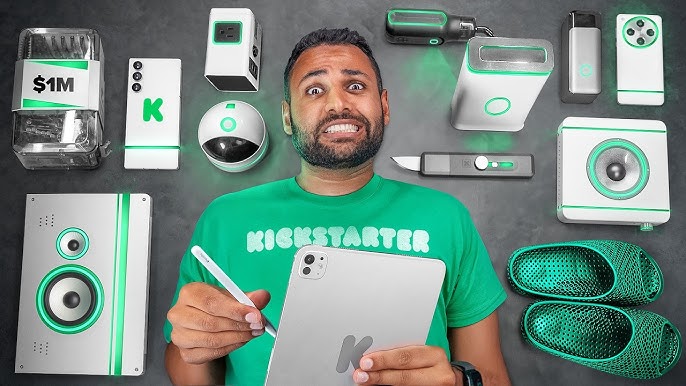
Ten months ago, I spent $10,000 of my own money buying the most futuristic tech products on Kickstarter. But because it’s Kickstarter, only half of them actually arrived. The other half have ended up being a combination of companies who’ve clearly run out of money trying to build their products, or just straight-up scammers trying to rob people. We’ll get to that.
But the question is, are the products that did arrive so incredible that it was still worth paying that insane amount of money, or are they actually just a kick in the teeth?
The $40 Disappearing Act: Roll Order
Kicking things off with the very cheapest one, the Roll Order. I backed this product thinking, “Oh, cool. A decently fast charger with a 90 cm retractable cable baked inside of it.” You always have everything you need without the cable taking up extra space or getting tangled in a bag. I paid around $40 for this, and I got nothing.
If you back a product on Kickstarter, there is no guarantee that you will actually receive it.
Now, you’re probably thinking, “BMathz, it’s right there. What are you talking about?”
This is the crazy part. After nine months of hearing absolutely zero from this company which, by the way, is enough time for me to have had my own child I decided to just look online. They listed the thing on Amazon. I bought it there, and that is the product standing here. If you can even call this standing.
I mean, this is actually how the thing arrived. It’s looking a lot less like “Roll Order” and a lot more like “Rolled Over.”
Kickstarter Success Rate Tracker: 0% (0 for 1)
Honestly, this just sucks as a company practice. Clearly, they decided they didn’t make as much money as they wanted to on Kickstarter, so they tried selling what stock they did have on Amazon. Meanwhile, their paid supporters who have been sitting there right from the very beginning are still waiting for their product a year later.
Also, I’m not just saying this because I’m vexed right now, but this just wasn’t worth it. The product itself feels—ah, flip. God damn it. I was going to say it feels fine. It feels like a decent quality charger, but just with a bunch of small red flags.
For example, this retractable mechanism doesn’t work all the time. Because you’re pulling in the same direction that your plug faces, there’s a pretty good chance that you will also pull the plug out of the wall in the process. It uses a USB-A port on the front, which is… it’s giving 2019. Most fundamentally, products like this have already been made by other companies, and I think they’ve done it better.
The Pokémon Card Ultimate Test: X Cutter
We’re not exactly on a roll with Kickstarter right now, but let’s keep track of the success rate. So far it’s zero, but maybe the X Cutter can save it.
This is the ultimate multifunctional box opener. It sounds a lot more like a Pokémon move to me, but that’s not actually why I paid for it. Constantly when I’m opening up boxes, I accidentally slice the actual thing inside. This claims to be a box opener that never cuts the contents, which we have to test.
This is what you get for basically $40. Well, you can tell they didn’t spend all of it on the packaging. Inside, you get some ink—this is for the overlay pen on the other side of the thing—and then the cutter itself.
The thing is apparently font-loaded with 10 functions in one: utility knife, saw, packing tools… and, uh, yeah. It’s kind of like they ran out of ideas after number four, but management said they needed 10 functions on their desk by tomorrow morning. Last time I checked, “made of titanium” is not a function.
Putting the “No Cuts” Claim to the Test
First impression: the mechanism does feel very responsive. I really like that the blade automatically retracts unless you’re actively holding it out. Tucking it away by default feels like a good safety feature. Although, to be fair, you can actually touch the blade with your fingers and it doesn’t even feel sharp.
Let’s put their “no cuts” claim to the test. There are two boxes here. Each one contains one of my rarest Pokémon cards.
First, the normal knife.
Oof. That didn’t feel good.
Now, the X Cutter.
Oh. It actually did a lot more dragging of the card inside. I’m not sure that was good for either of them.
Let’s check the damage. For the traditional knife… oh, that’s quite bad. There’s a very blatant line right through the middle of the card. And now for the X Cutter… oh dear. I mean, it’s not better. This is too much pain for one article.
On the other side of the X Cutter, we’ve got this redacting pen, which is made to basically conceal your address details before throwing out your boxes. It takes a little bit to get going. You can kind of see how obscuring this ink actually is, but it’s also not a “one swipe and your problems disappear” kind of situation.
Is this actually straight-up better than the $100 knife that I use for pretty much all of our unboxings so far, or is the only thing this company has actually cut their own corners?
Antibiotics or Just Carbon? The Pencil Hybrid Tips
This next one I was bursting to get inside of: the pencil-style Apple Pencil tips. I get that it doesn’t sound particularly interesting, except at the very start when I misread the name and thought it would allow your Apple Pencil to start dispensing antibiotics on the fly.
Then I looked at it properly and I realized, wait a sec—these guys are claiming to have made a better version of the Apple Pencil than Apple themselves. They promise replaceable tips that reduce slipping and noise, but also tips that can transition straight from writing on an iPad to writing on real paper.
It comes in this very protected, almost homemade-looking outer packaging. A ribbon on the outside… let’s get rid of that. Okay, there’s another layer. Sticky tab on top. Jeez Louise, more security steps here than my bank account. All right, there we go. This is a very unique-looking product.
Writing with a normal Apple Pencil feels great, to be honest. It’s very hard to look at it and say there’s a problem that needs fixing. I guess you could say it’s a little on the loud side.
Let’s swap out the normal tip for the pencil hybrid tip.
On the bright side, I wouldn’t say anything is particularly missing. On the downside, I also wouldn’t say this adds anything. Even though the tip is slimmer, it doesn’t feel more accurate because of that. If anything, my handwriting has actually gotten worse with it.
The Real Paper Party Trick
Now for the crazy bit: a real piece of offline paper. Because this tip is made of a carbon composite material, I should be able to transition straight from writing on the iPad to writing on the paper.
Success rate update: 50%
Holy cow, that actually works! That’s like one of the coolest party tricks that I’ve ever seen a tech product do.
But I hate to be this guy… is it actually a great pencil? This style of ultra-compact nib—which isn’t like a wooden pencil that you can just keep sticking through a sharpener—is never going to be as bold. It looks a little bit faint. It has higher friction on the paper than a normal pencil, and it just feels a little bit blunt. I’m curious if a normal eraser works on it… kind of, but not as well as I would want it to.
To draw a conclusion, I think all things considered, this is a pretty good product, taking us to a 50% success rate so far. But I also wouldn’t quite call it the best of both worlds.
The Ghostly Multi-Outlet Speaker & The Broken Cutter
This next one I thought was pretty cool. For $49, you get six AC outlets, four USB ports, 15-watt wireless charging, a light sensor, a portable Bluetooth speaker, a magnetic wireless charger, and a wall mount. Basically, someone made a real-life AliExpress listing.
But then they didn’t send the product. Did they forget that part of the process? The entire comment section is just people saying, “Where is it? I want a refund. Give me an update, please.” And no one is getting anything back. It feels crazy that this is the current best system for supporting upcoming products.
Intermission: Fixing the Box Cutter
While dealing with this, I opened the next box, and I started having box cutter problems again. Not a good start for this thing. The whole blade has just come out! Bear with me a second while I try and piece this together.
The blade rests in here, the pen at the other end goes in there, and then this slots back in. Okay. Well, this does make it somewhat better that at least when it does go wrong, everything seems designed to be fixable.
Walking in 3D: The $69 Printed Sliders
I’ve actually been on the hunt for the perfect sliders for quite a long time. I’ve been through Adidas, I’ve been through Nike, I’ve been through Crocs. There’s always something—either it chafes your feet a little too much, or it keeps coming off as you take your steps. That’s why I was really drawn to this project: the most comfortable 3D-printed shoe.
I paid $69 for these, which first off, nice, but also that’s a lot for a pair of sliders. They’re going to have to be quite mind-blowing to be worth that. Inside our shoebox, we got a branded tote bag, a keyring that is a tiny miniaturized version of the slippers I ordered (actually, Disha can use these, what a weird but cool extra), and then the shoes themselves.
Why actually 3D print a shoe at all? On first glance, I was like, “Oh, maybe they’ll custom-mold it to my exact feet shape.” But they didn’t do that. What these guys say the benefit of 3D printing is, is the ability to create a 3D lattice structure. This gives you 360-degree breathability, washability, and the fact that the structure will shift as you’re walking to eliminate the pressure points that build up on a normal set of sliders (which are basically flat planks of solid plastic).
My current best sliders are very comfortable and well-contoured, but they do make a little bit of noise—a light thud every time my foot hits the floor—and they’re a little bit squeaky.
Now, let’s try our 3D-printed shoes.
Oh, that’s different. I’m walking in 3D!
No, but seriously, you absolutely feel the way that the structure moves. You can really feel the part of the shoe that you’re exerting the most pressure on kind of flexing around that pressure, which feels good. Oh, yeah—and they’re also significantly quieter. This is actually so therapeutic. It’s like there are a thousand tiny, really soft springs just pushing me upwards with each step. It’s kind of like I’m floating.
The only thing is, I have pretty wide feet, so this part of the structure is digging into them a little bit. That’s a problem they could have fixed if they actually allowed you to custom-make them for your feet size. But still, it’s pretty mad. For a lot of people, I could see this being the ultimate slider.
Solar Energy Ls and Transparent Delays
Did we get the next one? Nope. Damn.
This is the Solar Energy S, which to me sounds an awful lot like a low-level Dragon Quest spell. In reality, it is a 40,000 mAh power bank with the ability to unfold a solar panel to charge it up. Am I disappointed that it didn’t become a thing? Yes. Am I surprised? No. Like, not even in the slightest.
Even though the thing raised $40,000, the number of times in conversation someone has suggested to me, “Oh, we should make this thing solar-powered because why not? It’s free energy and it’s always there” is endless. But the reality of solar is that it’s just too inefficient for day-to-day consumer tech charging. I’m guessing they probably got far enough along in the development process to realize that it sucked, and then realized that without the solar charging, this product already exists everywhere else.
The comment section is even more brutal. It looks like everyone’s trying to invoke some sort of clause to get their money back under Kickstarter’s terms of use, but I don’t think it’s going to work. Kickstarter’s current stance is very much like: if you have a problem, it’s not our problem. So, it’s more like Solar Energy L. That was $79 down the drain.
Here’s another $89 just gone. This one is particularly annoying just because of how cool it could have been. It’s a transparent display, but unlike the transparent TV that I’ve reviewed before, this one has a dedicated physical space behind it, designed around what you’re using that transparent screen to display.
This is one of those ones where it doesn’t look like an outright scam. They say they’re preparing to ship, even if they have had to remove the LED light strip from all units due to manufacturing issues. But how long is it going to take? Everything is so vague on this platform. If you’re someone who likes certainty like me, it makes it very hard to plan things around. I kind of wish they’d be a little more transparent.
The Level 1000 Alpha Chad Charger: Python 140W
Now we’re really kicking things up. This product had over $100,000 raised: The Python 140W mega charging hub. Supposedly, “the charger reinvented.” If I had a penny every time a tech company said that…
Oh, yeah, I remember why I backed this thing. This charger genuinely looks like the level 1,000 Alpha Chad version of the Anker Cube, which was my favorite desktop charger for a full two years.
This product actually arrived, but that’s also not the least bit surprising because Python is already a very established company. I always find it a little bit weird when this happens, but you can see why it makes sense for them. Even if you are a big company who knows there is demand for a product, why not just list it on another platform where people can pre-order it? It attracts a ton of extra eyeballs, which Kickstarter often does. Clearly, it works; this product managed to hit 600% of its funding goal in one day.
Right off the bat hot damn, this is a cool finish. The whole thing looks almost holographic.
(One extra thing to bear in mind for this X Cutter is it’s also not going to prevent damage to boxes if you’re cutting the plastic right on top of those boxes. One more sticky tab over here, and now we’re in.)
It definitely doesn’t have portability on its side. We’ve got one MagSafe connection up here for your phone, and that is completely adjustable, just like the Anker Cube. One thing I do really like is they give you one of these magnetic rings in the box, so I could attach this to the back of a phone that doesn’t have built-in magnets and make anything MagSafe compatible.
Obviously, it’s designed for more of a power user. You’ve got three USB-C ports and two big old main AC sockets on either side. This is made for someone who wants to power every single thing on their desk all at once. But I also can’t help but feel like they could have learned a thing or two from Anker, because there is nothing here to be able to charge a set of earphones wirelessy underneath the lid like you have embedded inside the Cube.
There is a charger for your Apple Watch that you can unscrew, take out, put on your desk, and use to charge like that via a USB A-to-C cable. But I’d actually argue that’s more of a negative than a positive. With this kind of watch strap, you kind of have to remove the strap every time you want to charge your watch on it. It is not a very elegant solution.
So, I would say the product is okay. It’s exactly what it says on the tin and nothing more. But this is a prime example of one of the true benefits you get on Kickstarter: if a product you’re backing does actually take off, there’s a pretty good chance you’re going to pay less than you would at retail. I paid $99 for this one, and the RRP now is $179.99.
Power Bank Identity Crises & The AI Pillow Scam
Okay, two more that didn’t arrive. The first is this $100 Foley smartphone expansion/new life partner—because one of those things definitely follows from the other. Why have they crossed out “smartphone expansion” on their listing? Did they change their mind halfway through?
To be honest, I can kind of see why. The idea doesn’t make any sense. It’s like a power bank, but one that’s also trying to become your second smartphone screen. They built their own mini-applications inside of it, like a phone dialer, a remote control for your phone’s camera, a voice recorder, and even maps.
Not to be mean, but who asked for this? Is there a single person on this planet doing any of these things on their phone who has ever said, “God, I just wish I could kick back and do this on my freaking power bank instead?” Anyway, the latest update here is just, “We’re working hard for mass production. We still have some issues to solve.” Yeah, you do.
Then my second big L was even more expensive: The Houthi AI pillow at $200, which just makes me really want to go lie down. Except I can’t, because I don’t have my pillow.
The concept is that this pillow stops you from snoring. That isn’t in itself new—you can already buy pre-existing smart pillows that detect snoring with a microphone and then gently inflate to move your head and fix it. But this was meant to be better because instead of a mic, it uses bone conduction. This should theoretically be way more accurate because it’s only going to pick up those vibrations if they’re specifically coming from you, not like your rickety old fan in the corner of the bedroom.
In hindsight, looking back at this listing, you can see the red flags clear as day:
“A new generation of anti-snoring pillows helps you deal with snoring problems when you sleep.”
It is the absolute definition of generic Adobe stock footage combined with a cheap text-to-speech engine. The AI voice couldn’t even say their own brand name right! And it’s not just the voice. They never actually show a working demo of the app itself. The only thing they show is the physical pillow. But I understand how a pillow works! The only footage of the companion app in this entire trailer is footage of the app literally not working. These are the kinds of things you should be looking out for if you’re deciding whether or not to back a project.
The Million-Dollar Battery Grid: OITE
This next one is almost a little bit hard to believe. The OITE battery charger and checker. Just to give you some perspective, while the Apple Pencil tips raised $30,000 and the X Cutter raised $69,000 (nice), this battery charger raised a cool million dollars.
Let’s unbox it. Just one little sticky over here. Ah, so this is another issue with the X Cutter—it’s not quite thin enough to easily get into all these tight cardboard nooks. It’s starting to feel a little more situational than just “the knife that solves knives.”
Oh, this right here is my favorite type of anti-static bag. You know when you see this metallic plastic stuff, you’re about to have a good time. Listen to this crinkle. Exceptional.
I’ve got a dozen or so AA batteries here that are all somewhat used. The idea is you just plop those into the top hopper. Let’s go a little nuts and throw them all in.
Then those batteries get funneled down into the middle section, which is the actual charging station. This is the really cool bit: it can charge four of those batteries at any one time, going from empty to full in 2 hours, which is about an hour quicker than most standard battery chargers. It doesn’t matter which way around you drop the batteries in either; it can charge both orientations automatically.
OITE Features:
• 2-hour fast charging
• Gravity-fed hopper system
• Auto-sorting orientation
• Live companion app tracking
This is the mobile app in action. It tells you the exact battery percentage that each of the batteries currently charging is on. You can schedule the charging windows, and you can also switch between standard and fast charging. When you go into fast mode, you can really hear the internal cooling fan kick in.
Then, when the batteries are done charging, they just automatically drop down into this bottom drawer section here, completely ready to collect and use again.
I don’t think when I bought this I fully appreciated how cool that is. It’s not just that this replaces all of your individual battery chargers; this also replaces any kind of battery organization drawer you might normally have. I love how easy they’re making it to switch over from single-use disposable batteries to rechargeables like this. It’s cheaper for the consumer, and it’s way better for the environment. The OITE is looking very good. This is definitely a Hall of Fame contender.
Dead on Arrival: The 1080p Nintendo Switch Rig
Are you ready to see the single most “dead on arrival” product to ever exist?
I actually loved this idea. It’s a portable gaming rig that upgrades the original Nintendo Switch from outputting in 720p handheld mode to instead outputting at 1080p. It does this by adding a new external display that basically tricks the Switch hardware into thinking it’s docked and displaying on a home TV. It also makes the side controllers feel a bit more ergonomic and controller-like, and it improves the built-in speakers.
I think this thing could have absolutely killed if it launched back in 2017. But the microsecond that the Nintendo Switch 2 was officially announced, this product makes zero sense. The next-gen console is going to have 1080p handheld gaming with none of this external hardware hassle, better controllers, and better speakers right out of the box.
Here’s the thing I’m finding really irritating about all of this, though. If you go onto their Kickstarter updates page, they specifically said—six months ago, by the way—“Thanks for all your support, we’re going ahead with shipping as planned.” But nothing. I’ve received absolutely nothing. So far, the success rate is looking pretty grim.
(I also backed a $250 portable camping shower around the same time. I don’t know why. I can’t speak for my headspace a year ago, but this one says “funding suspended,” which is good in the sense that my card didn’t get charged, but it still feels a little embarrassing.)
The World’s Smallest 5G Smartphone? Jelly Max
In better news, this is the Unihertz Jelly Max, which is apparently the world’s smallest 5G smartphone—although the box says “The Smallest 5G Smartphone?” with an actual question mark. So, is it? I honestly doubt it.
Isn’t it a bit baffling that one Kickstarter company can’t seem to manufacture a plastic tub and a hose for a shower, while this other company is out here building entire 5G smartphones?
The answer is that there are actually two very different types of companies on Kickstarter. There are the indie startups who actually genuinely need the crowdsourced funding, and those are the ones for which there’s a very decent chance you’ll never see the final product. But then there’s also this huge wave of established companies like Unihertz who don’t need the cash, but just use the platform for extra marketing visibility and guaranteed pre-orders.
Given how small they’re bigging this phone up to be, the box is a little on the chunky side. Oh no, even more box cutter issues with the X Cutter. It just can’t seem to handle slicing things at anything but a direct 90-degree angle. You know what? I think we’ve tested this tool enough. I don’t think this box cutter is quite the revolution I was hoping it would be. Back to the traditional knife.
Taking the top layer off… okay, yeah, the phone is a bit bigger than I was expecting. And damn, why is it so thick? There is a clear case pre-installed on there, but even without that, these are very stodgy proportions.
I stand by the stodginess comment, but at the same time… why is this like the most comfortable phone I’ve held in years? There’s something about this rounded, compact shape that feels way more designed for a human hand than a massive modern flagship. Holding both of these side-by-side makes you realize how much with a normal phone you’re constantly stretching out your palm just to reach across the screen.
I did get a pretty decent discount supporting it early. I paid $259, but if you go onto their retail website to buy the phone right now, it costs $330. For $250, there’s actually quite a lot of tech going on here. You get very decent mid-range specs all around, a pretty large 4,000 mAh battery, a customizable hardware key on the side (where you can make a single press do one action and a double press do another), and a 100-megapixel camera. That resolution smells an awful lot like marketing number bragging, but let’s try it.
Let’s take an iPhone 16 Pro Max and take the same shot on the Jelly Max over here. Oh, wow. Yeah, it’s not quite there, is it? God, computational processing software really is everything these days. Still, there’s nothing particularly terrible about the phone. It does exactly what it said it would do without any major red flags.
Wind Tunnels, Kung Fu Turtles, and Custom Stickers
Welcome to the final chapter of my wallet crying. I paid $289 for a desktop wind tunnel—essentially a miniaturized version of what aerodynamic engineers use to test model cars and planes. It got super delayed, and then the creators started asking backers for more money to cover shipping costs, which happens a lot on Kickstarter. I just dipped and wrote it off.
Then there was the Kung Fu Turtle. This is one of those desktop robot pets that feels like we see around all the time. It looks like this one will eventually be released, but it was originally meant to ship in November of last year. There’s a point at which a delay just becomes a permanent loss. I seem to remember a different Kung Fu Turtle who once said, “There are no accidents.” But this product definitely feels like one.
On the bright side, look at this: the LeanPix Cut S1. This is another product that raised almost a million dollars, and we actually got this one in the studio. Full disclosure, they are sponsoring this article, but as far as sponsors go, I don’t think we’ve ever had a cooler hardware product. This is essentially the first at-home machine in the world that can both print and cut any custom sticker you want to make.
Let’s say that I wanted to keep people away from my new 3D-printed sliders because we are having a bit of a free-for-all situation with footwear in this house right now. Can it make me a custom warning label for them?
First, it prints in multiple precise passes to make sure each color comes out vibrant. Then it applies a protective laminate film over the top of the sticker, and then… it just cleanly die-cuts the edge. That is so incredibly satisfying to watch. All I need to do now is peel off the backing and stick it down. The sticker quality feels incredibly high—even scratching at it with the metal edge of the X Cutter doesn’t leave a mark. They’re fully waterproof too. I literally used this machine yesterday to print out my own custom dream phone skin.
Turn Your Furniture Into a Speaker: Humbird
Oh boy, I am glad this next one came. This is apparently the world’s most compact full-range vibration speaker, which on first glance doesn’t look like it’s capable of producing much audio sound at all.
The company claims this is the best of everything because it uses bone-conduction style vibration transfer technology to turn whatever physical surface it’s sitting on into the actual speaker chamber, instead of relying on its own tiny built-in body. This makes the audio output completely 360-degrees and the device itself tiny enough to fit in a pocket.
We peel the sticky pad off the bottom—that’s going to mean you get the best possible acoustic connection with the surface you’re putting it on. Let’s stick it on our studio desk.
Hmm. Part of the issue here is it’s making absolutely everything on the table vibrate, which is adding a ton of rattling interference. That wasn’t exactly an acoustic success. Let’s try putting it on something else—the sticker printer.
That’s the interesting thing about this speaker: the way it works, it’s going to sound completely different depending on the specific object it’s sitting on.
Wow. 1930s radio, is that you? I think there are too many moving parts inside the printer chassis. Let’s pull up the absolute best-case scenario for this gadget: our cheap IKEA cabinet. This metal cabinet has ended up being one of the most underrated acoustic investments we ever made. Let’s stick it to the side door and open it up to create a big, wide hollow sound chamber.
Acoustic Surfaces Tested:
1. Studio Desk: Too much rattle/interference
2. Sticker Printer: Sounds like a 1930s radio
3. Metal IKEA Cabinet: Best bass/hollow chamber effect
The creators also keep talking about how these physical vibrations are meant to be mentally soothing, comparing it to an acoustic singing bowl. They even printed “Healing Through Sound Waves” on the manual. But honestly, I feel like that’s getting into the territory of: “buy this phone charger because its rounded corners bring serenity to your cosmic existence.”
Just buy a normal portable Bluetooth speaker. The retail price for them has come down so low that you can get amazing, full-range sound for like $30 to $50 now. Also, if you needed any more warning signs, it literally has the letters “BS” written as the product model on the box. Sums up the average state of the Kickstarter product ecosystem, really.
Making a Brand New Instrument: The Chromaplane
The next product is the Chromaplane. It’s an analog synthesizer played using handheld magnetic pickups that interact with electromagnetic fields on the board to create different electronic signals. To put it another way, these madlads have gone and invented an entirely new musical instrument.
Unboxing it… yeah, this right here is exactly the kind of plastic tape mess that the X Cutter was meant to save us from, but the traditional knife still feels like the lesser of two evils here.
Read More:iOS 26 Features: Everything New in Apple’s Huge Visual Redesign
At the very top of the box, it reads: Inspiration. Machines. Exploration. It’s making me feel like I signed up to go to space, not just paid a ton of money to sit in my studio basement waving magnets around. We get a nice little handwritten postcard with a thank you. See, it’s these kinds of personal, indie touches that I imagine Kickstarter buyers are genuinely seeking.
Here is our very unusual looking device. It looks way more like one of those old silver DVD players from the early 2000s than any musical instrument I’ve ever seen. Let’s plug it in and turn it on.
The closer you bring the handheld pickups to these marked-out dots on the chassis, the louder the electronic notes play. It’s very therapeutic, and it’s honestly the most put-together sounding experience for someone who has never interacted with a specialized instrument before. If you give a random person a cello for 5 minutes, it is not going to sound nice like this. This is kind of what I imagine heaven sounds like… or a really good luxury spa.
One thing the manual says you can do is feed in a backing track audio song from your phone via an auxiliary cable. The music plays out, and as I bring the magnetic pickups closer to this specific dot, I can live-remix and modulate that track with all these other frequency nodes. Look, it’s not Martin Garrix electronic music, but I think it’s fair to say I’m not the core target market for this. I don’t really know who the target market is, but this device is exactly what it said it would be on the tin. I knew what I was buying, and it delivered on that niche promise. It’s one of those rare examples of a great product that isn’t from a massive tech conglomerate, made possible by Kickstarter and Kickstarter only.
The $1,400 Broken Gym Box: AdopPie
We’ve had some pretty strange stories already, but this next one is the absolute strangest. This is the Gym Pad Bench. It’s one of those high-tech all-in-one workout boxes trying to take over your entire home gym setup.
We bought it for $1,399, by the way. And the massive crate did actually ship and arrive at our door, so we’re all good, right? Yeah, not quite.
Here’s the massive issue: the product literally does not work. It’s a “Kick-stopped,” if you will.
The physical bench part itself is comfortable and feels fine. You lift that top padded section up, and then inside you have to push this internal metal framework out—which is slightly confusing because the chassis actually has the word “PULL” printed on it, but there is physically nothing to grab and pull.
Then you lift up this dual cable pulley system. It definitely has a bit of a sketchy, homemade feel to it, which is not exactly what you want when you’re buying heavy fitness equipment designed to test your physical lifting limits. The idea is you raise these pulleys to whatever height you want depending on the specific exercise you’re trying to do, and then it locks in.
But this entire mechanism feels incredibly stiff, and not in an intentional, heavy-duty way. Pulling this cable system in various ways is what all your workouts are based on, because underneath the bench, it uses a digital motor to create magnetic resistance instead of physical iron plates.
I wouldn’t say there’s anything wrong with the core tech concept of the product. It’s just that we physically cannot power the thing on. We’ve tried like five different power cables and outlets that we know for sure are working perfectly, and the machine is just dead.
If that wasn’t already enough of a red flag, just look closely around the build quality. These adjustment pulleys are supposed to be completely locked in position, but the entire bench frame shakes wildly when you apply any force. The main control dial feels horribly cheap and plasticky.
There’s also the fact that we specifically paid extra during the campaign to have the rowing machine extension included. Where is it? I have absolutely no idea; it wasn’t in the crate. We also thought we were getting weighted handles, and that’s not a crazy thought given that they are literally pictured on the freaking retail box!
The thing isn’t even called the Gym Pad Bench on the unit itself. They didn’t even deliver the product name they said they were going to! Clearly, they ran into some sort of legal trademarking issue late in development, because the unit I received is branded “AdopPie.” I am just completely baffled that if this is the broken, unfinished state of the hardware, why even bother shipping it to me at all? Why not just take the extra time to finish engineering it, or just scam me properly and keep the cash?
The $4,900 Holy Grail: B6 Swift Laser Engraver
Did we really spend $4,899 on a single Kickstarter product? Yes, we did. Should you spend $4,899 on a Kickstarter product? Probably not, but let’s find out what that kind of money gets you.
This is the B6 Swift industrial laser engraver. It came to us in this massive shipping box containing this huge bottom piece—which is the heavy structural base and power supply unit—and then this smaller top piece, which is the actual high-power laser head itself.
I am a little overwhelmed by the sheer possibilities here. In theory, this machine allows you to permanently etch or print anything onto pretty much any material surface. Just to give you an idea of the accuracy, yesterday we laser-printed a detailed Squirtle Pokémon graphic onto this solid metal dog tag. Look at the texturing and the fine detail! Not to mention just how mad it is that you can actually print in vibrant color on raw metal using nothing but a laser beam. There is no ink being used here at all; the machine is essentially controlling the temperature of the beam down to the millisecond, which controls the exact level of oxidation in the metal to shift its color.
Let’s try something absolutely crazy. We’ve already printed a custom vinyl skin for a phone, but what if we just use the laser to engrave a design directly onto the glass back of a phone?
We line the phone up on the base plate. This is so freaking cool. We’ve imported our channel logo into the computer, and the machine uses a low-power framing laser to project a preview showing you exactly where that logo will appear on the physical body of the phone before you hit confirm. The companion software is super advanced, but it’s not actually made by this indie startup—it’s just industry-standard general use laser engraving software they bundled with it.
Three, two, one, go.
Wow. Oh my god, that is absolutely insane! It is easily a top-five coolest tech product I have ever interacted with in my life. This is incredibly impressive.
It looks like something about the matte texture on the back of our first test phone kind of interfered with the beam cutting depth process, so the logo edge isn’t quite as perfectly precise as it could be. I want to do it again on a different device.
Let’s run the pass… and that actually looks… wow. That looks like a flawless factory finish. There is absolutely nothing on the smooth surface of the glass that would even imply it’s been tampered with after the fact.
Just to laser in on how absolutely insane the power of this hardware is: this laser is powerful enough that it can also cleanly cut right through sheets of metal. Let’s say, for example, I wanted to make a custom metal necklace pendant. We pull open a digital photo of everyone’s favorite studio cat, chuck the file into the computer to automatically generate a 3D depth map so the laser knows exactly how deep to cut into the metal blank, and give it about two and a half hours to run its passes.
Look at what it came up with. Oh my god, what the flip? I can’t actually wrap my head around how insanely detailed this physical coin is. My eyes aren’t even good enough to see all the lines without a macro lens. It has engraved down to a microscopic level, capturing every single individual cat hair. It’s almost a bit too much detail. That right there has just completely rocked my world. This is one of those highly specialized products that only 0.1% of the population should ever even consider buying, but its technical output is absolutely extraordinary. It is completely deserving of Hall of Fame status.
The Verdict: Is Kickstarter Worth It?
Finally, let’s check back in on the state of our million-dollar OITE battery station. Look at that—everything has funneled down to the bottom tray. All of these rechargeable AA batteries are now completely filled up.
But you want to see the coolest hidden feature? This separate side rejection tray right here… yes, it works. It automatically filters out and holds all the inserted batteries that are either physically unable to hold a charge anymore, or are just straight-up dead single-use alkalines you dropped in by accident.
It’s obviously not a perfect product for everyone, because for a lot of people, the tech era of swapping out loose AA batteries is nearing its close. Also, this specific unit only accepts standard AA sizes; if you wanted to be fully covered for AAA or C batteries, you’d theoretically need multiple different versions of this machine. But still, what a genius hardware product idea that actually functions perfectly and makes your daily life better.
So, to answer the ultimate question: do I recommend backing projects on Kickstarter?I would say generally, no. If you’re just casually browsing the platform and backing anything random that catches your eye, you have a literal 50% chance of the product never arriving or the company ghosting you. And then even if the box does show up at your house, there’s only about a 60% chance that the physical hardware actually lives up to the lofty marketing claims the creators had to make just to get funded.
However, if you strictly stick to backing established tech companies who already have a proven manufacturing track record and are just using the platform for pre-orders, it can be an amazing, legitimate way to get a sizable early-bird discount and get the newest tech in your hands months before anyone else. Just watch out for the stock footage and the AI voiceovers.