
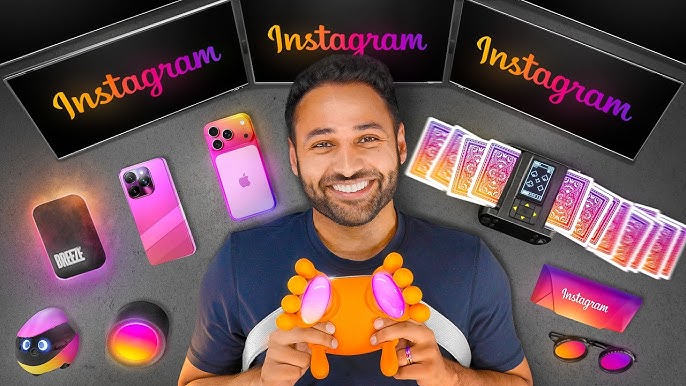
I Spent $25,000 on Instagram Ad Gadgets to See What’s Real
I spent $25,000 on an Instagram ad to buy this machine. I’m going to put my phone on there because, in theory, this thing can print anything onto anything with three-dimensional texture. I can drag a marble layer on top of my phone using the software, and then it should actually be able to print a real marble-like finish onto it. Let’s see what it looks like when it’s done.
My team has spent the last 10 weeks trolling Instagram. Every time they saw a gadget that looked wild in an ad, they bought it. 16 products have shown up. Let’s use this to find out: are these social media products actually as perfect as the ads make them seem?
Screen Cleaners, Shoe Bags, and Watch Bands
First up: Water Bears. These are tiny little cleaning cloths that safely clean your lenses and screens. They don’t look like cleaning cloths, and they stick straight to the back of your phone. When you’re done, you just stick them back in place.
That feels a little too easy. Here’s what I want to know: how well do they actually clean? Pretty well, especially considering there’s no solution or spray. It’s a pretty solid connection to the back of your phone or laptop, to be fair.
Now, there are a couple caveats. If you stick this into even one poorly maintained pocket, it gets so grim. It picks up a ton of rubbish that you’re not really going to want to wipe your screen with. Plus, the more times you do this, the more the pad is going to start to lose its stickiness. The good news is apparently both of those issues are solved by just dunking it in some water. I’m going to say that $15 for this Instagram ad was money well spent. I 80% love it.
Next is a laundry shoe bag. Stop doing what you’re doing with your white sneakers. This is a specific bag designed so that your shoes can go straight in the washing machine. I’m very interested. Maybe this is because I’m just about to enter my 30s, but I am buzzed about this one. Being able to throw your shoes into the washing machine is already one of my favorite life hacks. The idea of doing that while protecting the machine and cleaning the shoes even better is a big win-win.
Pretty impressed by the quality here. These were more expensive than they looked, so it’s reassuring that they also feel better than they look. There are a thousand bristles inside of here. Let’s go absolute worst-case scenario: shoes covered in mud. One shoe goes in each bag, the zips tuck in, and it’s go time. Let’s check back in a few hours.
While we wait, let’s look at this Apple Watch band. Right off the bat, you can tell what they’re doing with the packaging. This outer box is clearly trying to come across like the luxury orange and black Hermes aesthetic. It’s just when you get inside, it becomes pretty clear that this is actually more the clear, crinkly plastic bag AliExpress aesthetic. First off, got to applaud them for the name—looks like they made a typo and then just stuck with it forever. Game recognized game.
Every single segment of this band is its own magnet. That is delightful. That is just not coming off. If that looked sus, I’ve actually been wearing a $1 watch band that I got from India almost two years ago at this point, just because I thought it was really funny that it’s every bit as good as the watch bands Apple is charging $50 for. But I think it’s finally time for an upgrade. This is a definite step up while still being cheaper than Apple. We can keep the joke running.
The $50 Toolless Smart Light
You’ve probably seen tons of smart lights, but you’ve never seen a smart system like this. This is the Halo Lux lamp by Glowite. It’s a wireless, clutter-free light. You just peel, stick, and attach the light with a magnet. Voila. Magnets involved? I’m liking the sound of this a lot.

We got the goods, and I wouldn’t call it a hugely premium first impression considering it is $50 a bulb. Wait, I just turned it on. Well, that actually is kind of cool because at least you know it really does work right out the box. That’s kind of the entire appeal of this product. This is clearly designed for someone whose priority is a toolless experience.
The magnet is very strong, and the sticky pad mounts easily to the wall. It feels a little bit too easy, and I kind of want to say that’s because it’s not secure—but it freaking is.
You tap the light button to turn it on. I really like the design. We’ve actually got one end at the top which is diffused, so it’s softer, and then the bottom one is not diffused, so it’s sharper. You can change which one is being lit by using a button, hold it down to change brightness, and change color temperature. It’s so simple, but it’s actually so insane to use a product that is exactly what it says on the tin in the easiest possible way. There’s always something that you normally have to fiddle with, like an app, a Wi-Fi connection, or screws. Do the settings persist when it’s turned off and on again? Yes, they do. It has memory.
But then there’s the sensors. We bought the hand sensor, which is designed if you want to be really intentional about when you’re turning things on and off. You just swipe from left to right, and it is so responsive. Swipe again, and they turn off. That’s not something you’re going to accidentally trigger, which is exactly what you want.
There’s also a motion sensor for when you don’t even want to think about it, with three options for how long you want the lights to stay on. My guard was up when I saw the $50 a pop pricing, but this is a well-designed product. They have somehow managed to fit a $10,400 mAh battery inside of here, which should last a month. The magnet means that you can very quickly detach it to USB-C charge it when it runs out.
Camera-Style Sunglasses and the Probiotic Mouth Spray
Next up: sunglasses that are supposedly “too dark to see.” What does that even mean? Oh, wow. They have lenses that adjust kind of like ND filters on cameras. They’re not bad looking either. Nothing too experimental going on with the case; it’s all looking pretty generic so far.
The glasses themselves—I think I actually like them. God, they’re really heavy, though. You see how they just kind of fall out when you’re holding one of the arms? Let’s check the tint mechanism. Wait, what? No hope. It’s really weird to see out of glasses where one side is tinted and the other isn’t. The manual rotation doesn’t sound or feel satisfying at all, which is half the reason I bought them. It’s freaking stupid. I feel misled. I feel betrayed. I was really looking forward to the idea of a fidget toy permanently attached to my face, but yeah, that ain’t it.
Let’s do a UV test card. When you shine a UV torch onto it, it turns purple. Let’s shine those same UV rays through the glasses. Okay, almost nothing gets through, so they do block UV. But I just think it’s a bit silly. These are as expensive as glasses that can automatically tint themselves, but they’re manual. You have to do it twice, and the mechanism isn’t even nice. This is our first mistake.
Right, let’s check in on our phone in the 3D printer. What? It’s got all the veins of the natural stone. That feels like the kind of custom finish that you’d pay a company hundreds of dollars to get done. I just realized I forgot to cover up the flash module while doing it—that’ll be a fun experiment to excavate later. Consider me very impressed by that. Because it’s printing using an ink that hardens just by being exposed to UV light, it can even print on metal in 3D. In theory, you could just print unlimited metal posters at home that would normally cost you $50 a pop. Let’s get a metal sheet in there.
Now for something called Breeze Spray. Why does that sound like something you’d use in a bathroom to kill 99.9% of bacteria? The ad says: “Why I’m never asking my friends for gum or mint anymore.” Oh, it actually does kill bacteria, but just in your mouth so that you can stay having fresh breath. Interesting idea, I will say. Why does this look incredibly AI-generated? It calls itself “Kiss.” They’ve really decided what their audience is.
If the glasses are the product that I know I don’t need, then the breeze spray is the one that I hope I don’t need. Got to say, nothing about this presentation screams “I’ve just dropped nearly $100 on something.” The thing itself is super light. I initially thought this is just a nice, pleasant breath smell, but apparently this is the hard stuff. This spray bathes your mouth in a probiotic mist that kills 99.9% of the bacteria responsible for bad breath. They’re claiming that compared to mints or gum that might give you about 2 hours of extra fresh breath, this gives you 12.
Let’s put my money where my mouth is. That is delicious. It’s quite powerful, a little bit mentholy. We bought the mango flavor, and if you’ve ever tried Rubicon juice, this is that, but just with a really strong cooling effect in my throat. It’s one of those weird ones though where, technically speaking, this is the product, but you’re paying most of the price for the dispenser. Then again, if the thing does solve bad breath forever, it’s worth every cent. We just wait for a couple of hours and then I’ll breathe on my wife’s face for the moment of truth.
A Whiteboard Wallet and a Musical Ball
Next is New Things Lab. It’s a wallet that you put your cards in, but then you unfold it and it’s also a whiteboard that you can write on. I am curious if this will actually feel convenient compared to just jotting notes in my phone.
The packaging is actually a little bit more premium than the fun stocking-filler vibe that I was getting from the ad. I guess it kind of has to be if they’re going to charge $89. Oh, that’s a nice magnetic snap. I could definitely get used to that. To be fair, it’s actually kind of nice to write on. The pen glides, it’s got a good level of precision, and the eraser on the back makes it very easy. When you’re done, the pen stores right inside the case. If I shut it and let it rattle around in my pocket all day, the notes stay perfectly intact.
That said, do I think this is good? Probably not. Because the eraser on my pen is slightly worn out, it doesn’t secure in properly and keeps falling out every time I open the thing. See, the problem is if you don’t put your cards in just right, you will actually end up sliding them into the middle and completely destroying your notes. Even if you put them in really carefully—three on one side, three on the other—if you haven’t perfectly pushed them all the way in, you can’t open the wallet. Then you push them all the way in, and you can barely get them out because it’s so tight. It’s two things that sound like a really great pairing on paper, but it doesn’t work in practice. It’s a decent whiteboard, but it’s a bad wallet.
Then we have this ball that makes music. Every time it bounces, it plays a note. Yes, of course, there’s an app. You can even mix your voice in with the whole thing. This is a very strange hybrid of two products I did not imagine going together. Consider me confused.
The very obvious immediate question that springs to my mind is: who is this for? Is this a tool or is this a toy? It’s connected to my phone, and the idea is that different gestures produce different sounds through the phone. There’s no speaker on the ball itself, which is very strange. You can assign what sound comes with what motion and layer it up to form a beat.
Read More:The “Enshittification” of Tech: Why Everything You Use is Suddenly Worse
This is actually so stupid, but I mean, I’m kind of impressed. It’s a nicely made product with a slick app. It’s just, having used it, I can tell you for sure this is firmly in the toy category. There is no way Taylor Swift was in the recording studio shooting three-pointers with her Oddball to try and create a hit song.
Shoe Results and a Bed of Spikes
All right, it’s shoe time. Feels like Christmas morning. This is a two-part investigation: how clean are the shoes, and how clean is the bag? Do we need to throw the bag in the wash again afterwards?
The zips have stayed in place, which means they weren’t rattling around in there. That’s a pretty good result. It’s not perfect—some of the deeper stains are still there—but it’s 97% cleaned. Look at this, though: the inside of the bag is pristine. I’m assuming these mesh nets on the sides filter the dirt out. I’m not mind-blown, but they’re good enough that I would use these from now on.
Next is the Shakti premium acupressure mat. You just lie down on it, it gives you some sort of acupressure therapy, and then it folds up when you’re done. Those reviews online are absolutely insane. I’m very curious where this is going to land on the pain-pleasure scale, because the idea of lying down on a bed of a thousand spikes does sound more like a sadistic torture method from a cartoon than therapy.
Ow. Oh my god, that really is pointy. The idea of acupressure is that your body is covered in hundreds of acupoints where blockages in the flow of energy can occur. By poking those points, you relieve the blockages. I don’t know about the energy stuff, but I have had acupressure massages before and they’ve been great.
Huh. Lying down, it actually feels fine. It’s that weird thing where if it was one spike, it would absolutely kill. But when you spread that surface area across thousands of spikes, it just feels like I’m lying on a really bristly rug. There is something really grounding about it. I feel comfortable, but just very aware of myself. Also really impressed by the quality of this thing. After 15 minutes, I’m not in pain, but you absolutely know that you’ve been thoroughly prodded. My back feels really warm, kind of like you feel after a really good workout, except I’ve probably burned two calories. I feel really alert all of a sudden. Quite limbered up.
Aesthetic Acoustic Panels and a Card Dealing Robot
Can you hear the difference? That’s a vast reduction in echo, achieved with just four of these Audio Silk panels. Honestly, this is pretty tantalizing. These are super thin and pretty sleek looking as far as acoustic panels go. If they actually end up performing as good as the ad suggests, I think I’m just going to put these all over my house.
In the entrance way of our house, it’s pretty terrible acoustically. What you want is lots of soft fabrics and furniture to absorb sound waves, but we have a flat concrete floor and plaster walls. You notice tons of audio reflections bouncing all over the place, which muddies the clarity of my voice.
We put eight of these panels up in the room—two sets worth a total of $240. Can I tell the difference? I would say yes, definitely. It’s not eliminated all reflections by any stretch, but it’s about a 40% improvement to the room. The best part is that you can barely see them. It’s a triple win: it reduces reflections inside the room, reduces noise coming into the room from outside, and reduces noise leaving the room to go to other rooms. We might be seeing more of these around in the future—or rather, not seeing them because they blend in.
Next up: a card shuffling and dealing machine. You put two sets of cards on either side, it shuffles them, and then it deals the cards to the players. You can select how many players are playing, up to a max of six. I feel like this is the kind of product that could become essential, but only if the execution is perfect. If it’s finicky to use or needs a lot of setup, it is just going to gather dust in a corner because, ultimately, it’s not solving a problem that’s particularly difficult to solve manually.
Let’s test it with two completely fresh packs of cards—one red, one blue—so we can see how thoroughly it shuffles. Yeah, this is doing exactly what I thought it would do. For the most part, it’s just taking one card from the red, then one from the blue, back and forth. It’s not a perfect random shuffle. It would actually benefit from some pre-shuffling if you take your card games really seriously.
You control it with these remotes. It’s got a bit of a non-slip base, which is a nice touch. Let’s say we’re playing poker. You set the number of players on here, and it actually lets me go all the way up to 10. Oh, I’ve just realized “Max 6” is just the name of the product, not the actual capacity. That’s such a user experience flop.
When you hit the remote, it deals. I expected the card throwing to be a little bit more chaotic, but each one pretty much landed in the same formation. If you had a human dealer throwing cards at people, it wouldn’t do that good of a job. It even burns a card automatically before dealing the flop, the turn, and the river. It understands the game and tells you on the screen what card is coming next.
What’s also cool is you can fit a bunch of different sizes of cards into this—playing cards, trading cards, even Uno cards. If each player takes their own remote, they can just tap it to request a card on their turn. I’m actually so impressed by that. Wow. Maybe I could finally get some friends.
The Alien Massager and a Smarter Security Cam
This next one is a very strange looking product. The idea is you just have this thing dangling around your neck throughout the day while it massages you with human-like hands. It really does look like a little alien doing a Naruto run. I’m actually already a little terrified of this one, and not just because it shares a name with a boss fight from Super Smash Bros.
There is absolutely no need to give this thing fingernails or toenails or whatever the hell these things are. When you turn it on, all of these fingers start kneading you. There’s a button that separately controls the heat, and you wear it so it rests on your neck with straps that wrap around you like a backpack. Kind of feel like I’m giving it a piggyback.
Let’s try it. Ah, feel like I’m being seized from the back. Oh, okay. No, you know what? When it starts, it targets the tension perfectly. This is actually just how I like it—really hard and firm. You could get used to this, and you kind of have a headrest everywhere you go. It looks like Shrek is giving you a back massage, but Shrek couldn’t do it this good. You look like a total weirdo walking around in public with it, but would it be worth it? I’m going to have to say yes.
Next is a robot called the Patrol Bot. The ad made it look like a long-distance relationship communication device, but it’s actually more about home security, which makes a bit more sense. It’s basically like a Roomba mixed with CCTV. It’s got a dock that it can return to automatically, and at any point, you can log into the app, drive it around, and see what it is seeing.
It’s actually kind of nippy. Why does it sound like Mario? The feed quality is not bad at all. It’s a little bit strange because it’s the least intimidating possible form of a patrol bot I’ve ever seen. I’m just imagining being a thief and having this thing walk up to me. It feels more like it’s designed to entertain a child or a pet. It drives on carpet, though, which is actually quite a difficult thing to do, so it must have some pretty good tracks on it. Footage could do with some stabilization, though.
I hate that I actually like this. It’s more real than I expected, and having control to move around does make it feel like there’s a mini version of you there. Also, the actual recorded video quality is quite a lot sharper than the live stream on the phone. I still wouldn’t choose to buy one, but it’s not as bad as I thought it was going to be.
E-Ink Photo Frames and a Cheap Phone Markup
This next one is a really interesting idea. Kind of like the Samsung Frame TVs, you can display any image on them and it makes them look like paintings. But the upside here is that it’s using e-paper. E-ink consumes almost no power. I am very interested. The only thing I’m thinking is: does the e-ink make the image look less good?
I’m a massive fan of set-it-and-forget-it gadgets like this. As soon as you introduce maintenance or batteries that need to be charged regularly, you’re way less likely to actually use something. This manages to sidestep all of that because the battery lasts so long that you can display over a thousand different photos on a single charge. The only time this type of display drains any power is when you’re changing what’s on it.
To transfer an image, you select a photo in their app, and then you just tap your phone onto the bottom corner of the frame. Literally like Apple Pay, it transfers the image to the frame. It takes about 30 seconds, and it’s cool seeing it move the e-ink particles into position.
The problem is, I just don’t think it looks quite good enough to use. For reference, we printed the same photo onto glossy photo paper ourselves, and it looks a hundred times better. It’s brighter, the colors look more natural, and the resolution is way higher. If this was half the price, it would maybe be recommendable. You’d have to swap the image a massive amount of times to justify how much more expensive and worse this is than just putting a standard photo in a frame.
Speaking of overpricing, let’s look at this easy-to-use phone for older adults. The ad says fast, reliable 5G and sharp photos, but I have doubts. The presentation is actually kind of nice. You’ve got a labeled SIM ejector, a stylus (which makes sense for people who prefer pen and paper), a clearly laid out charger, a case, and a pre-installed screen protector.
The primary value-add here is a new software skin that turns the full complexity of Android into a simple list, which is pretty nice and readable. But the compromises are immediately obvious. This display is not a $400 phone display. They fenced off the user interface so that it doesn’t go to the top part of the screen, which just makes it feel like a poorly optimized app.
Wait a second. This is actually not the same phone as featured on their website. I notice a sticker on the back that looks like a tactical move to cover up a brand. Let’s peel it. It’s an Oukitel phone. A quick search on AliExpress shows it’s a cheap Oukitel model. Looking at the back, two of the cameras don’t even look like they have real lenses behind them. Let’s open the camera app—yeah, there’s just a standard lens, no telephoto, no ultra-wide. Fake phones do that. Oukitel is at least a legitimate budget brand, but it’s pretty clear what’s happening here. Someone has imported a very cheap phone from China, added a few inexpensive extras like a clear case, a software skin, and a basic stylus, and they’re using those things to reposition the phone so they can massively upcharge it.
It gets stranger because there is a subscription service that goes along with this for an extra $30 a month. For that, you get your calls, texts, 4 gigs of data, and access to a 24/7 customer support hotline. Let’s actually try calling them to ask how to download an app. The support agent who answered was actually kind of delightful and offered to walk me through it step-by-step.
I really don’t know what to think here. This product is simultaneously very clear with how it’s making money on cheap hardware, while also still being genuinely useful for that specific older demographic. If you do not care about specs, the user interface is very clear, the customer support is amazing, and the monthly plan lets family members remote into the screen to help out. It’s different, that’s for sure.
The Quad-Monitor Laptop Extender
This is the Aura Display Triple Boost. You get three extra monitors from your one laptop being plugged in via one single cable. This is one of those products that looks absolutely sick in adverts, but I’m so curious if it feels incredibly clunky in reality.
Unboxing it, the inner box was upside down—a bit of a red flag because it signals a lack of attention to detail. The device itself is made entirely of aluminum, so Tim Cook will be happy. It is chunky, but way less chunky than you might expect given that it has literally three monitors packed inside. It isn’t attached directly to the laptop hinge, which makes sense because you would completely destroy your laptop trying to support that weight. It doesn’t feel tremendously secure, but it is cool that all of this is powered by one single Thunderbolt cable.
Each of these screens is 14 inches, which matches my Mac perfectly. From a distance, the setup looks epic. It is the easiest way to have a quad-monitor setup that just works, but it’s not as good as doing it properly. When you look up close, it is very obvious that these screens are not MacBook quality; they’re basically 1080p IPS panels. Anything that needs precise color or high resolution, you’re still going to want to do on your main screen.
Personally, I wouldn’t use the Aura Display. If I wanted a permanent home setup, this isn’t close to the quality that you can get from three dedicated, proper monitors. And if I was traveling, I just don’t feel like you need it. If you want to multitask on a browser like Opera, you can just use split screens, sidebars for your work messages, and pop-out video players. Plus, powering three separate extra screens on the go completely nukes your laptop battery. The Aura Display delivers on what it promised, but it’s such a niche proposition that I just wouldn’t use it.
The Verdict
Let’s check back on that $25,000 custom UV print on the back of my phone. Oh my god, that is so impressive. You can actually feel the creases in the shirt and the contours of the fabric. I can feel the brickwork in the background of the image and even the bits of graffiti. That is kind of mind-blowing because the machine decided completely automatically what bits needed engraving. It is incredibly expensive, and I don’t know what I would do with it on a day-to-day basis, but you cannot argue with the result.
It has also been nearly four hours since I sprayed myself with the Breeze Spray. I had my wife test it, and she said it just smells like absolutely nothing. That’s the best thing anyone could possibly say about your breath, right? It easily outlasts an equivalent piece of gum. The ingredients list doesn’t look all that positive, but you are only consuming it in very tiny quantities. I’d probably give it an 80%.