North Korean Smartphones: Inside the Hidden Tech of Smuggled Devices
The Han 701 and Sam Taung 8
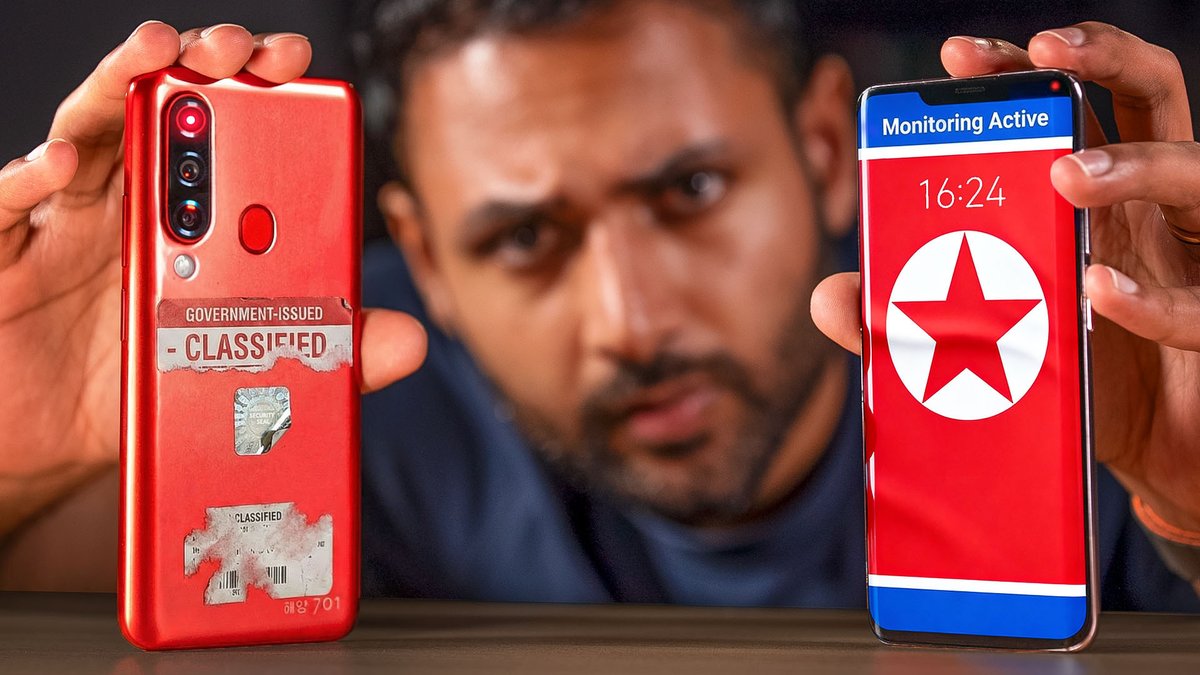
These are two extremely rare phones from North Korea, and it’s kind of insane that I’m even holding them. The North Korean population is so cut off from the outside world that it’s almost impossible to even get a text message out, let alone two fully functional smuggled phones that show us in crystal clear detail what it’s actually like to be a North Korean citizen.
So, this is the Han 701. It’s one of the country’s budget phones. Just to give you an idea of how little is known about this stuff, you can Google the phone’s name and nothing will come up. absolutely zero. And then the second is the Sam Taung 8 which is a flagship North Korean phone. And yeah, this is different to South Korea’s Samsung, which translates to three stars. This is Sam Taung, which translates to three huge stars.
You’re going to be seeing a lot of this whole my dad could totally be up your dad energy. But that’s because convincing North Koreans that they are superior to South Koreans, that they are morally purer and militarily stronger is about the most effective way of keeping them loyal to the government. And it’s pretty clear when you look at these phones that the smartphone is playing a big part in that.
Real-Time Censorship and Language Control
I can actually show you this right now by trying to type on these phones. So if I write Namhan, this means South Korea. The second that I hit the space bar, that gets autocorrected to puppet state. It is bonkers seeing censorship this explicit happening in real time in front of my eyes. You physically cannot send the word Namhan even if you try, which shows just how committed North Korea’s government is to sustaining its narrative that South Korea is this inferior, less individual country that just blindly follows whatever the US asks them to.
Other ways of wording it like Republic of Korea, that doesn’t even get corrected. That just turns straight into asterisks. Kind of like you’re a child and you just tried to make your Club Penguin username a swear word. And you can actually see the censorship becoming more invasive as time is going on because if we use this Han phone which came a few months before this one lets you write North Korea as North Korea. But the Sam Taung doesn’t even let you do that.
The only way that you’re allowed to refer to North Korea now is Joseon, the traditional name for the Korean Kingdom. And then South Korea almost as if they’re belonging to them as South Joseon. But it gets worse because Daily NK News, the guys who actually secured these phones in the first place and whose basement I’m sitting in right now, they’ve probed around and found all sorts of extra oddities in the software. Like how if you type Kim Jong-un, the name of the current leader, into any app, it will make the text bold the second you finish the word. Or how all sorts of South Korean slang is just subtly corrected to the more proper North Korean approved way of saying the same thing. presumably because a lot of this slang originates in some capacity from South Korean media and the North doesn’t want their population to even indirectly experience that.
Read More:Best EDC Gear 2026: The Ultimate Everyday Carry Guide for Techies
But probably the single craziest example of this is if we type oppa. This is a common South Korean expression that can be used to mean either older brother or in slang terms boyfriend which in itself does raise a few questions on these North Korean phones. It corrects the word to comrade accompanied by a warning. This word can only be used to describe your siblings. Imagine getting a warning for attempting to type a slang word. That’s moderation on a level that I have never experienced before.
The Internet Situation and “Mirae” Intranet
But I would say even more significant than autocorrect. The biggest factor in controlling information going in and out of North Korea. And the main reason that the country is still this cryptic bubble and we barely know these phones even exist is the internet situation or really the lack of one. Look at this. On the Han phone, you can swipe down from the top and you see your control panel that looks basically the same as every other Androids. And there’s even a Wi-Fi button there. But when you press it, absolutely nothing happens. Weird. But let’s go into settings to click on Wi-Fi directly. But you can’t.
And they’ve actually gone a step further with this more recent Sam Taung because you go into the quick settings, there isn’t even a Wi-Fi icon at all. It’s like they don’t want you to even consider that the feature could be as accessible as that. The only way to get something that even resembles Wi-Fi is this. It’s called Mirae, and it needs so many details from you, including your government ID and an authenticated North Korean physical SIM card, that it’s pretty safe to assume everything you do while using it can be traced right back to you.
And even with all of that, this still doesn’t get you onto the internet. There’s actually no way for a North Korean citizen to do that. All this can get to you is access to a highly curated North Korean Intranet where you can look at specifically government approved TV news propaganda and apps. More on that in a bit. But the key thing to know for now is it doesn’t look like it would be a great experience. The app itself tells you to expect speeds between 2 and 33 megabits per second, less than a 14th of the speeds that South Koreans are getting on their public Wi-Fi.
I imagine the way that North Korea’s leaders are seeing this is they know that the second they give their population access to the open worldwide web, it’s game over for being able to control the way they act and think. But then at the same time, they can’t give the people nothing if they’re trying to convince them that their country is truly superior to all others. Hence, this careful substitution of traditional Wi-Fi features for this highly traceable Wi-Fi equivalent that reinforces national pride as opposed to diluting it.
Hardware and Manufacturing Origins
But those speeds are so dated. And to be honest, everything about using both of these phones feels dated. Like, it’s pretty sad that this Sam Taung is one of their modern flagship phones. It was only released recently in 2023 in North Korea. It was priced pretty close to $1,000, but it looks like a mid-range Huawei phone from 2021. Actually, let me be clear. It really looks like a mid-range Huawei phone from 2021. I’m almost getting deja vu looking at it.
The way the camera module has an identical style and position. The way the body and the screen curves around in a seemingly identical way. Even this incredibly unique Huawei style cutout around the buttons and this red line in the middle of the power key is the same. Plus, for security reasons, I’ve got to keep the IMEI number hidden. But when we traced it back, it does look like this phone was manufactured in China, just like Huawei phones.
So, I think there’s two possible explanations. Either this phone was actually secretly made by Huawei themselves and supplied to North Korea for them to add their software layer or Sam Taung just decided we like the look of that one. Let’s copy it because you’re about to see this yourselves. But so much of the content on these phones is copied content already. Why not the phone design too?
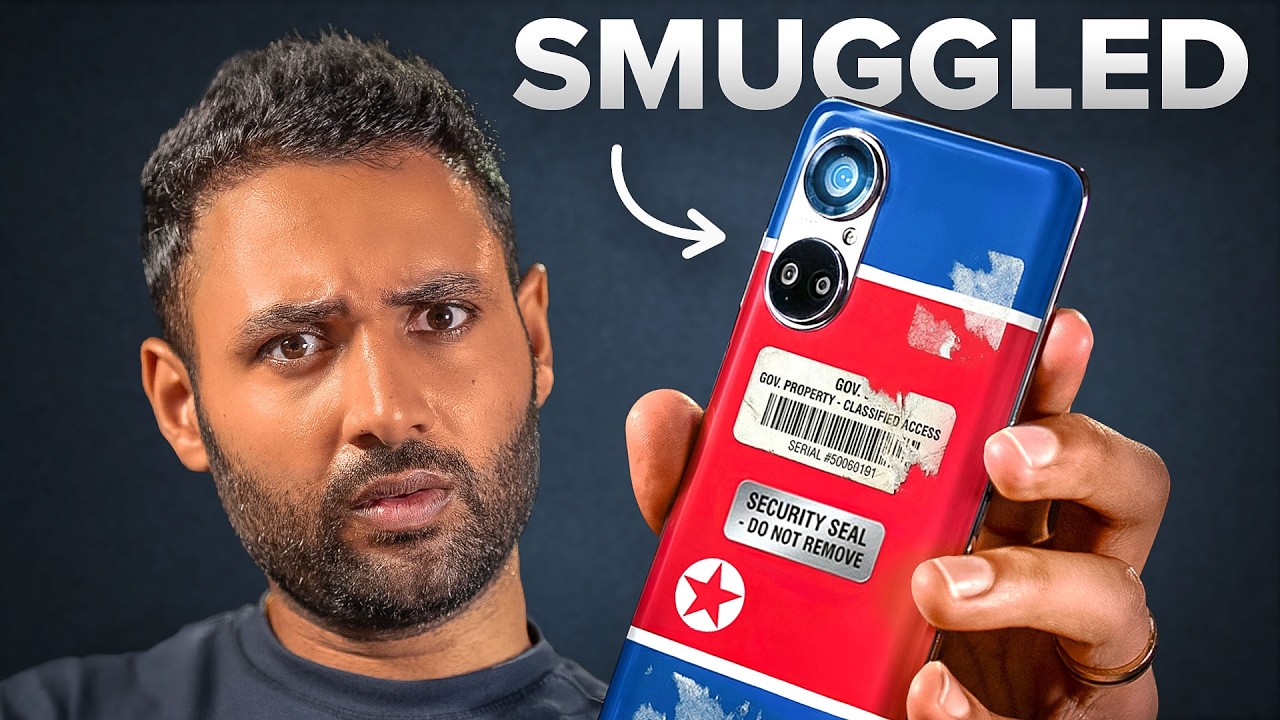
But also that unlike the Huawei that this looks so similar to, this phone does have a thicker bezel and a notch. this extremely tasteless font on show throughout the whole user interface. And then the only form of branding on the camera is a feebly written 64 megapixel that gives me absolutely zero reassurance it’s going to be a good experience. And it is not.
On the Han phone, we’re just getting extremely poor, grainy image quality all around. And even though there are three cameras on the back of this phone, there is still no ultrawide and no zoom. So both extra cameras are just useless macro and depth cameras. a trend that globally speaking started to die out pretty fast after 2020. And so the idea that this thing released in 2023 with that kind of setup shows the time lag that we’re operating with here.
And then on the flagship Sam Taung 8, the camera is super buggy. We couldn’t even get it to flip around to the rear cameras. And it’s also got this really unusual watermark plastered over it, which when we reverse it spells out, please contact Hinatron. Now, I did a little digging and turns out Hinatron is a small private China based company who makes a lot of smartphone parts. So, it kind of looks here like they’ve supplied some of the bits for this phone, but then North Korean Sam Taung has just like not paid their license fee or something.
Regardless though of whether this phone is a secret Huawei collab or just a blatant ripoff, it doesn’t change the fact that it is terrible value when you consider the global market. But that makes a lot of sense. With North Korea, we are talking about a very unusual market that has almost no competitive pressure. There’s almost no incentive to give people cutting edge tech. And if anything, the more dated the tech, the simpler it is and therefore the easier it is going to be to control. That would also explain why the Han is still running Android 10 with seemingly no ability to update beyond that and why Sam Taung is stuck on Android 11, making it 5 years worth of updates behind current Android.
Software Mimicry and Pirated Content
Let me show you what I mean by all this copied stuff. So there is an app literally here with a Microsoft Word logo. You open it up and it gives you the option for Excel, PowerPoint and Word. But I can assure you what you are getting here are not Microsoft apps. Not even close in functionality. I would actually go as far as to say that at least 50% of the icons that you see on these phones are stripped directly from other companies like File Manager and Compass. Those are basically Huawei icons that are very slightly reskinned. Maps is an almost one to one of the Google Maps icon. This random game uses the same icon as the Mobi Office work application.
Let’s just zoom out for a second. Even the official Sam Taung wallpaper, I’m pretty sure they have literally just downloaded the wallpaper from an Honor phone and then added an eight to it. And then if I go over here to the about phone section, I recognize that image. That image is actually stripped straight from the promo material of the completely different looking Huawei Mate30 Pro phone from years ago. And yet it is serving as the poster image for the Sam Taung 8, which makes me side with the theory that this is a copy of Huawei as opposed to made by Huawei. Cuz if it was made by Huawei, surely the company would use an image that at least matched the design of the phone.
There’s a whole library of informational videos that you can buy as part of North Korea’s intranet. Like this one all about the football club Arsenal. And on the face of it, you’re like, “Oh, this is really premium. How professionally produced. But look a little closer and you can see this is actually ripped straight from an Amazon Prime series. It’s just instead of stay in the game, it’s titled Sweat for the Win.” And it’s got the logo of a North Korean company plastered across the entire length of it. But there is literally no way that this North Korean company could have bought the license to sell this content since there are literally sanctions on US companies like Amazon for collaborating with them.
There’s games too, tons of them. But I just want to show you this football game for a second. It opens with bizarrely the same logo that we just saw on the Amazon Prime show. So it seems like this is some sort of large scale media redistribution brand who’s taking international content and making it North Korea compliant. Then we see the bootup screen with the game’s title being International Soccer League 2.0, which is just so interesting because this shot of Messi’s face, I reverse image searched it, is not from International Soccer League 2.0, but instead a screen grab from a trailer of Japanese-made Pro Evolution Soccer.
The other thing that I think is absolutely fascinating about this football game is the Asian players are missing. Like you can select the team Tottenham Hotspur with all the correct roster as of 2022 when the game was launched, but with the only South Korean member of that team, Son Heung-min not present. They just chopped him. Again, presumably to not show North Koreans that South Koreans have proper international athletic careers.
The North Korean App Ecosystem
In fact, just the general situation with apps in North Korea is so different to what you and I are used to. The first thing that jumps out is there’s just so many of them. Like, have you ever seen this many apps pre-installed on a smartphone? This right here is a medicine app, but a medicine app where you can order whatever you might need for home delivery. There’s maps with navigation, too. Although, fascinatingly, it doesn’t show a clear dividing line between North and South Korea, and also doesn’t let you zoom any further out than the country itself.
It’s a little bit more advanced than I was expecting in some ways, too. Like there’s a store here where you can buy things like smartwatches and TVs all using an electronic wallet and it’s part of the internet. It’s also on this phone really surprising to see if we look past the logo that is very clearly just an NBC ripoff. This is online gambling with even the option for sports betting as well as just a pretty hefty catalog of video content that you can download onto the phones.
But you can also see that the North Korean government’s influence permeates every layer of this. Even the types of movies available. I couldn’t find one from the US or South Korea, but Russian movies, loads of them. Remember, the criteria here is not which movies does the North Korean population like the most. It’s which movies does the regime want the population to watch. And so, it makes sense that it’s all filled with Russian content since Russia is one of North Korea’s closest political allies. And Russian ideologies line up very closely to North Korean ones.
There’s also, weirdly, a bunch of Indian movies, including ones that I’ve seen before, like Three Idiots. The link between North Korea and India isn’t as clear-cut. But the guys from Daily NK have a theory that Indian culture hits a bit of a sweet spot. It’s kind of different enough to seem exotic and interesting to North Koreans, but while still not posing a threat to their culture in the way that Western content does.
And then there’s just a whole load of apps that feel not just guided by the government, but directly requested by them. Like this one is entirely biographies of past and current North Korean rulers. Something else I’ve never seen before is a general guidance app which is split into four categories. Laws, regulations, a legal dictionary, and then common sense, which really is exactly what it sounds like. It’s so strange. It’s like, how should we legally understand the family? Who are relatives? Can’t relatives marry? I wonder if the idea is giving every single person the same set of ideologies and learnings and even there’s like a humor section here so that they effectively become the same person to squash individuality.
There’s even a cooking app which guides you through how to make traditional North Korean cuisine. And all of these more official looking apps, they open by first showing you a famous quote from one of their leaders, which so feels like something you’d see on the loading screen of a dystopian video game, but this is real life. And then there’s also just a ton of games to play. Why is this one booting up with the Delta Airlines logo? Most of them feel pretty simple with a big emphasis on offline play, which is true for the whole phone experience. It’s actually wild how much we’ve been able to show and do. And that’s all no doubt because the internet situation in North Korea is so sketchy.
The In-Person App Authorization System
So crazy amount of stuff on both of these phones. But there’s a very good reason for that. See, getting new apps is not as easy for North Koreans as it is for us. They have an app store. You can download apps on your own. But, and I can’t actually quite wrap my head around how this is the reality, you can’t open those apps until you’ve taken your phone to an in-person store where they will authorize them for use and download the necessary backend data for them to function.
And believe it or not, there’s an extra wrinkle that comes with this. Your apps in North Korea expire. So, this one here is telling me it’s run out and is basically asking if I want to pay for 6 months or for 12 months for a bit of a discount. Effectively making every app a paid subscription, even ones you would not expect to be, like the laws of North Korea. Bearing in mind, North Korea is one of the poorest countries in the world with its national income per person being just 3.4% of that of South Koreans. This feels like a pretty tough pill to swallow. I think it’s likely that just the concept of being able to sustain a large library of apps is a luxury that very few will be able to afford. And that’s assuming you can even afford the phone in the first place.
Surveillance and the “Red Flag” Software
Now, even if you did find a way to sideload your apps without going to a physical store for that authorization, or if you found a way to get around the app expiration system, which we realize you could temporarily do just by changing the date on your phone to an earlier one, there’s a very important reason why you might not want to try that in North Korea, and it’s called Red Flag.
Red flag is an underlying layer of surveillance software that appears on all phones sold in North Korea. We know it exists because we can see the effects of it. And I’m told older versions used to be really easy to see and get around. But in these newer phones, Red Flag is now baked into the lowest level of the Android software, making it almost untraceable and impenetrable. Plus, it blocks off developer settings, which you can normally unlock by tapping this build number several times, meaning that it stops you figuring out what is really going on behind the scenes.
But the idea of Red Flag is to persistently make sure that what you’re doing on your phone is legitimate. So every file, every app, every photo that you take has a digital signature, a record that signals to the phone where that file originated from. Red flag makes sure that the only files or apps that can be opened on these phones are either ones with the North Korean government signature or a self signature, which is files that originate from the phone itself, like photos from your camera. Anything else originating from anyone else won’t have an approved signature and so will not open. it’ll just get automatically deleted by the software when it’s sent to one of these phones.
Now, that doesn’t seem to have stopped people from trying to get unauthorized content to work. There was an extensive report from Martin Williams and Nicholas Shice which goes into how some would try to skirt the system by opening foreign files via the phone’s web browser, but now that the signature checks are happening on a deeper device level, it can pick those up. It doesn’t work. or there was a Daily NK report last year that mentioned while North Koreans couldn’t store outside videos on their phones, they could insert SD cards containing the material into their phones instead.
However, there is one final very sinister surveillance feature clearly designed to deter any attempts at this. These devices, both of them, will take periodic screenshots as you’re using them. You don’t see these screenshots being taken in the same way that you’d expect to, but you know it’s happening because I can actually show you the folder where they’re being stored. I can see this has actually been taking screenshots today while I’ve been recording this article. The frequency of the shots seems to vary, but it’s many times per day. And the most alarming part of it is all you can do is look. You can’t click on them. You can’t check them. You can’t delete them.
Now, whether the phones are sending those grabs over the internet to the government continuously or if they’re just used when an official has doubts about you and wants to specifically confirm their suspicions, it’s anyone’s guess. But would you want to risk it in North Korea? Based on accounts from people who’ve escaped, this is a country which since at least 2020 has had a law that spells out distributing and even just watching South Korean entertainment is punishable by death. People who distribute this content are tried alongside drug criminals. It’s considered the same tier of crime, which says a lot about the priorities of the regime.
So, it really feels like every part of these devices, from the words you’re allowed to type to the videos you’re allowed to watch, are designed to reinforce a single narrative. North Korea is superior. Foreign influence is dangerous. And everything you do is being watched. It makes me very grateful for how easy tech is made for the rest of us. I’m kind of curious, compared to the hour that it would take to go to a physical store to install a single app on a North Korean phone. How long does it take to install an entire internet connection with Saily, our sponsor? So, search for South Korea. Click that. Let’s do 5 GB, $10.99. Go next. It’s loading. And I click Apple Pay. Buy with Apple Pay. And payment is processing. confirming order, processing order, and done. 20 seconds. That’s not bad at all. That’s basically why I’m using a SIM plan right now in South Korea. It cost me $10. And because Saily supports almost every country, it doesn’t matter where you’re going, you can just have one app for all your travels. So head to saily.com/bmathz and use the code bmathz for an extra 15%.